
Reliable Power Is More Than a Backup Generator
For modern businesses, electrical power is not simply a utility—it is a critical part of daily operations.
Data centers, factories, hospitals, banks, telecommunications facilities, commercial buildings and other critical environments depend on stable electrical power to keep their systems operating safely and continuously.
A short power interruption can result in:
- IT system downtime
- Data loss or corruption
- Production interruptions
- Equipment damage
- Security system failures
- Financial losses
- Disruption to customers and employees
That is why a reliable power strategy should not depend on a single piece of equipment.
A properly engineered critical power infrastructure combines UPS systems, batteries, generators, automatic transfer systems and electrical distribution into one coordinated solution.
1. UPS Systems: The First Line of Power Protection
A UPS (Uninterruptible Power Supply) provides immediate protection when the incoming electrical supply becomes unstable or fails.
Unlike a generator, a UPS does not need time to start. It can provide continuous power to connected equipment while also protecting sensitive electronics against common electrical disturbances.
UPS systems can help protect against:
- Power interruptions
- Voltage fluctuations
- Electrical noise
- Frequency variations
- Voltage sags and surges
- Short-duration outages
For critical applications such as servers, networking equipment, industrial control systems and telecommunications infrastructure, an online UPS can provide a highly controlled power supply.
However, UPS runtime is normally limited by the capacity of its battery system.
This is where the next layer becomes important.
2. Batteries: The Energy Behind the UPS
The battery system determines how long a UPS can continue supplying power during a utility failure.
Battery selection should therefore be based on the actual application rather than simply selecting the largest available battery.
Important considerations include:
Required autonomy
How long must the critical load remain powered?
Load capacity
What is the actual connected and future expected load?
Battery technology
Depending on the application, solutions may include VRLA, AGM, Gel or other advanced battery technologies.
Operating environment
Temperature, ventilation, installation space and maintenance requirements can significantly affect battery performance and life.
Future expansion
The battery system should ideally accommodate expected increases in critical load.
A properly engineered battery solution can provide the bridge between utility failure and generator availability.
3. Generators: Long-Duration Backup Power
While a UPS can provide immediate power continuity, generators are designed to support critical loads for much longer periods.
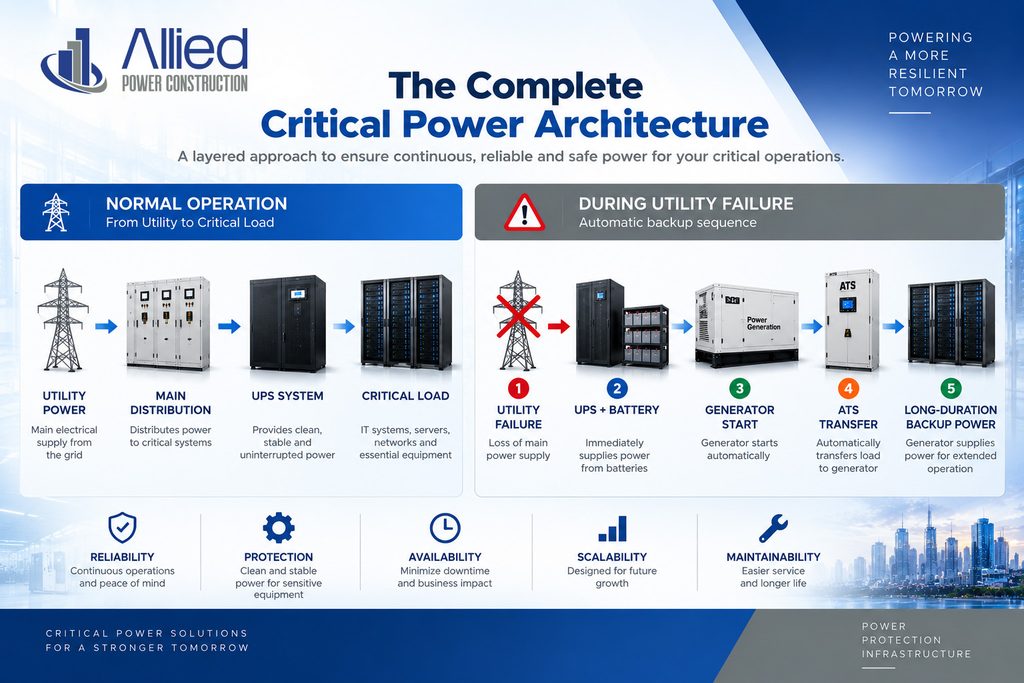
When utility power fails, the typical sequence is:
Utility Failure → UPS Takes the Load → Generator Starts → ATS Transfers Load → Generator Supplies Long-Term Power
This coordinated approach provides both instantaneous protection and extended backup capability.
Generator systems can be configured for:
- Standby power
- Prime power
- Critical facilities
- Industrial applications
- Data centers
- Commercial buildings
- Telecommunications
- Healthcare facilities
The generator should be correctly sized according to the site’s electrical load, starting currents, power factor, expansion requirements and operating conditions.
4. ATS: Connecting the Power Infrastructure
The Automatic Transfer Switch (ATS) plays an important role in generator-based backup systems.
When the main utility supply fails, the ATS can automatically transfer the designated loads to the generator once the generator reaches the required operating conditions.
When utility power is restored, the system can transfer the load back to the normal source according to the configured control sequence.
A properly engineered ATS solution helps ensure that the transition between power sources is:
- Automatic
- Controlled
- Reliable
- Safe
- Appropriate for the connected loads
5. Electrical Panels Complete the Infrastructure
UPS systems and generators are only part of the overall solution.
Power must also be safely distributed throughout the facility.
This is where properly engineered electrical panels and distribution systems become essential.
Allied Power EG provides solutions including:
- MDB — Main Distribution Boards
- SMDB — Sub-Main Distribution Boards
- ATS Panels
- MCC Panels
- Control Panels
- Power Factor Correction Panels
- Generator Synchronization Panels
- Changeover Panels
The electrical distribution architecture should be designed to coordinate with the UPS, generator and facility loads.
The Complete Critical Power Architecture
Why Integrated Engineering Matters
One of the biggest challenges in critical power projects is treating each component as an isolated product.
A generator supplier may focus on the generator.
A UPS supplier may focus on the UPS.
An electrical contractor may focus on the panels.
But the customer needs one system that works together.
The engineering process should consider:
- Total facility load
- Critical and non-critical loads
- Required autonomy
- Generator capacity
- UPS capacity
- Battery configuration
- ATS requirements
- Electrical distribution
- Future expansion
- Environmental conditions
- Monitoring and alarms
- Maintenance requirements
This is why system integration and commissioning are just as important as equipment selection.
From Design to Commissioning
At Allied Power EG, our approach covers the complete project lifecycle.
01 — Site Survey
We evaluate the existing electrical infrastructure, connected loads and project requirements.
02 — System Design
Our engineering team develops an appropriate architecture for the required application.
03 — Equipment Selection
We help select suitable UPS systems, batteries, generators, ATS equipment and electrical panels.
04 — Supply & Installation
Equipment is supplied and professionally installed according to project requirements.
05 — Testing & Commissioning
Systems are tested individually and as an integrated power infrastructure.
06 — Maintenance
Preventive maintenance helps identify potential problems before they become operational failures.
Building Power Infrastructure for the Future
Reliable power infrastructure should not only solve today’s requirements.
It should also support tomorrow’s expansion.
As businesses add servers, production equipment, networking systems, security devices and other electrical loads, their power infrastructure must be capable of scaling with them.
A well-designed solution therefore considers:
Reliability + Protection + Availability + Scalability + Maintainability
Together, these elements create a stronger foundation for critical operations.
Final Thoughts
A generator alone does not create a complete critical power system.
A UPS alone does not provide long-term backup.
A battery alone cannot protect an entire facility.
The real value comes from integrating UPS systems, batteries, generators, ATS equipment and electrical distribution into a coordinated infrastructure.
At Allied Power EG, we provide integrated solutions designed to help organizations maintain power continuity, protect critical equipment and keep essential operations running.
Power. Protection. Infrastructure.
Need a reliable power solution for your facility?